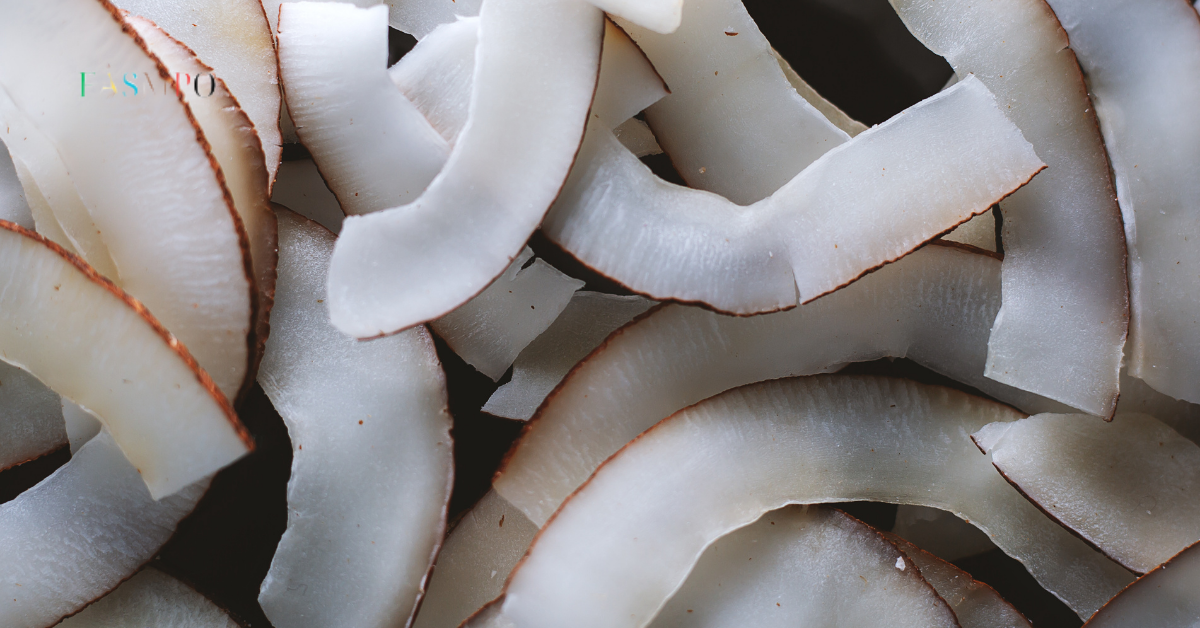
Learn about the production process of Vietnamese dried coconut that meets export standards, from raw material selection, preliminary processing, drying, testing, packaging to international shipping documentation...
Dried coconut Vietnam is gaining increasing attention in the international market thanks to its abundant tropical raw materials, long-standing processing experience, and growing demand for coconut products. However, for a shipment of dried coconuts to enter the export supply chain, businesses cannot rely solely on good prices or readily available supply. More importantly, the production process must be stable, food safety risks must be controlled, and the requirements of each importing market must be met.
In the coconut industry, the term "dried coconut" can be understood in various ways. Some refer to dried coconut flesh as the raw material, while others refer to dried shredded coconut, dried coconut slices, dried coconut chips, or other dried ingredients used in food processing. This article focuses on the production process of dried coconut for export, particularly dried coconut flesh and dried shredded coconut – products requiring strict control over raw materials, hygiene, moisture content, impurities, color, flavor, and packaging.
From my perspective, Quoc Hung – representative of FASMPO, a standardized process is not just about modern equipment. That process must begin at the raw material source, go through each controlled production stage, be clearly documented, and end with a traceable, testable, and delivered batch of goods as promised.
1. Selecting raw material sources that meet requirements.
The first step in the process of producing dried coconut for export is selecting the right source of coconuts. Good raw materials largely determine the quality of the finished product. Coconuts used for producing dried coconuts typically need to be of the appropriate maturity, with thick flesh, a natural white color, a characteristic aroma, and no signs of spoilage.
In Vietnam, coconut-growing regions in Ben Tre, Tra Vinh, Vinh Long, Tien Giang, and some provinces in the Mekong Delta have a significant advantage in cultivation experience. However, not all coconut sources are suitable for export. Businesses need to evaluate raw material sources based on factors such as production stability, harvesting methods, transportation conditions, sorting capabilities, and the level of control over residues or impurities.
For international customers, the origin of raw materials is increasingly important. Businesses should establish a system of area codes, supplier lists, procurement logs, and material acceptance standards. This helps increase traceability when customers request it or when quality checks are needed after delivery.
_20260528153529.png)
2. Harvest and transport to the factory.
Coconuts used for making dried coconut must be harvested at the right age. If the coconuts are too young, the flesh will be thin, the oil content low, and it will be difficult to produce a standard product. If the coconuts are too old or poorly stored, the raw material may develop an unpleasant odor, lose quality, or become moldy.
After harvesting, coconuts need to be transported quickly to the processing site or factory. During transportation, strong impacts and contact with mud, dirty water, or other sources of contamination should be minimized. For exported food products, the risk of contamination doesn't only come from the factory but can begin right from the raw material collection and transportation stage.
Professional businesses typically have clear regulations for receiving raw materials. Any batch of coconuts that do not meet the required maturity, have a strange odor, are cracked, rotten, contaminated, or of unknown origin must be discarded before being used in production. This is a crucial step to reduce risks in subsequent stages.
_20260528153546.png)
3. Inspect the raw materials.
When coconuts arrive at the factory, the quality control department needs to conduct an incoming inspection. This inspection typically includes checking the external appearance, maturity, condition of the coconut flesh, smell, signs of damage, impurities, and uniformity of the batch.
Some factories may take samples for further evaluation of parameters such as moisture content, oil content, or microbiological indicators, depending on the product and customer requirements. The goal of this step is to ensure that only suitable materials are introduced into the production line.
Input inspection should not be done subjectively. Businesses need a record-keeping system, rejection criteria, responsible persons, and a plan for handling substandard materials. When exporting, input control records are a crucial part of demonstrating quality management capabilities.
_20260528153606.png)
4. Remove the shell, separate the flesh, and extract the coconut.
After meeting the input requirements, the coconuts are sent to the process of separating the shell and extracting the flesh. This stage requires a lot of experience because incorrect handling can mix in shell fragments, fibers, dirt, or crush the coconut flesh.
The coconut flesh after separation must retain its natural white color, be free from contamination, and have no strange odor. In certified factories, tools, workbenches, production areas, and workers must comply with hygiene regulations. Employees must use appropriate protective equipment such as gloves, masks, hairnets, and work clothing.
For exported dried coconuts, removing physical impurities is a crucial requirement. Even a small piece of shell, metal fragment, plastic fiber, or foreign matter can lead to a complaint regarding the shipment. Therefore, businesses need to strictly control the process from the coconut flesh separation stage, not waiting until the end of the process to detect any issues.
5. Peel off the brown skin.
After separation, the coconut flesh often retains a brown outer layer. For many dried coconut products exported, especially white shredded coconut, this brown layer needs to be removed. The removal process must ensure that the coconut flesh is not excessively coated with the brown layer, while minimizing material loss.
If not peeled thoroughly, the finished product may develop brown spots, affecting its color and quality. If peeled too deeply, the loss rate increases, reducing production efficiency. Therefore, businesses need to train workers, control tools, and have clear standards for the percentage of remaining brown peel.
In modern factories, this process can be assisted by mechanical equipment to increase productivity and uniformity. However, whether done manually or semi-automatically, the goal remains to ensure that the coconut pulp is clean, naturally white, and meets the requirements of the final product.
6. Wash and clean the coconut flesh.
After peeling, the coconut flesh is washed to remove dust, impurities, remaining shell fragments, and other surface contamination risks. The water used in food production must meet hygiene standards. This is crucial because substandard water can become a source of microbial contamination.
The washing process needs to be controlled in terms of time, water quality, frequency of water changes, and equipment hygiene. After washing, the coconut pulp should be drained or quickly transferred to the next stage to avoid prolonged water retention, as high humidity creates favorable conditions for microbial growth.
In the HACCP system, the washing process is often considered a critical control step. Businesses need to clearly identify potential biological, chemical, and physical hazards that may arise at this stage, and then establish appropriate preventive measures.
7. Cut, grind, or grate according to product specifications.
Depending on the order, coconut flesh can be sliced, shredded, ground, or shaped into various sizes such as extra fine, fine, medium, flakes, chips, shreds, or special forms. This is the basic shaping step for the product.
The cutting method directly affects drying time, uniformity, sensory qualities, and product application. For example, finely shredded coconut is commonly used in confectionery or processed foods, while coconut slices or chips are suitable for ready-to-eat products, cereals, or toppings. Therefore, businesses need to clearly understand the customer's intended use before production.
Cutting, grinding, or grating equipment must be cleaned regularly to prevent the accumulation of oil, old coconut debris, or impurities. Poor cleaning can lead to cross-contamination, altered odor, or increased microbial risk in the product.
_20260528153620.png)
8. Blanching or preheating
Some dried coconut production processes include blanching or preliminary heat treatment to reduce microbial load, stabilize color, and aid in the drying process. The processing time and temperature need to be set appropriately to avoid losing natural flavor or affecting the product's structure.
This process needs to be controlled by specific parameters, not based on the operator's subjective judgment. Insufficient processing can lead to a high risk of microbial contamination. Over-processing can cause the coconut to become soft, discolored, or lose its characteristic flavor.
For export products, customers are often concerned about consistency between batches. Therefore, businesses need to record heat treatment parameters, operating time, test results, and the person in charge of each production batch.
_20260528153635.png)
9. Drying – the step that determines quality
Drying is a core step in the production of dried coconut. The goal of drying is to reduce moisture content to a suitable level, maintain the natural white to creamy white color, preserve the characteristic flavor, and minimize the risk of spoilage during storage.
Drying temperature, drying time, material layer thickness, and airflow all affect product quality. Insufficient drying can lead to dampness, mold, or reduced shelf life. Over-drying can cause the product to yellow, become hard and dry, lose its natural flavor, or increase the rate of crumbling.
For exported dried coconuts, moisture content is one of the most important indicators. Some international standards allow a certain maximum moisture level, but many customers may specify stricter requirements in their contracts. Therefore, businesses need to produce according to specifications agreed upon with customers, not just relying on the minimum level of general standards.
Professional factories typically use industrial dryers with temperature and time control capabilities. After drying, the product needs to be cooled in a clean environment before being transferred to sorting or packaging.
10. Screening and size sorting
After drying, the dried coconut is sieved to sort by size and remove any unsatisfactory fragments. For dried shredded coconut, the size of the particles or fibers is crucial because each customer has a different production formula. A product that is too fine, too coarse, or uneven can affect the customer's processing.
The screening process also helps remove some physical impurities if present. However, businesses should not rely entirely on screening. Impurity control must be implemented throughout the entire process, from raw materials to final packaging.
After screening, the product is usually sorted into categories according to internal standards or order requirements. Each category needs to be clearly labeled with a batch number to avoid confusion during storage and shipping.
11. Inspect for metals and impurities.
For food exports, foreign object control is an indispensable requirement. Factories should use magnets, metal detectors, or other suitable equipment to detect the risk of metal contamination in finished products. This step is especially important if the production line has many metal cutting, grinding, screw conveyors, or belt conveyors.
Besides metal, businesses also need to check for other contaminants such as plastic fragments, packaging scraps, fibers, shell fragments, hair, insects, or foreign objects. A shipment found to contain foreign objects can seriously damage the supplier's reputation and may even lead to customers temporarily suspending cooperation.
The best approach is a combination of prevention and inspection. Prevention involves maintaining factory hygiene, equipment maintenance, tool control, and personnel training. Inspection involves using equipment, taking samples, and recording results before packaging.
12. Quality control of finished products
Before shipment, dried coconuts need to be tested according to product and market requirements. Common indicators include moisture content, oil content, color, smell, taste, impurities, microbiological indicators, and chemical or heavy metal residues, depending on customer requirements.
For export orders, businesses should prepare a COA – Certificate of Analysis – for each shipment. A COA helps customers verify the product based on specific parameters and demonstrates the professionalism of the supplier.
Businesses can conduct testing in their own in-house laboratories if they have the necessary capabilities, or send samples to an accredited independent laboratory. For demanding markets, results from third-party laboratories are generally considered more reliable.
13. Packaging meets export standards.
Packaging is crucial for protecting product quality throughout the warehousing, transportation, and international shipping processes. Dried coconuts are often sensitive to moisture, odors, and contamination, so the packaging must be moisture-resistant, clean, durable, and food-grade.
Depending on the product, packaging specifications may include multi-layered kraft paper bags, inner PE bags, cardboard boxes, PP bags with liners, or other specialized packaging. The packaging must include essential information such as product name, net weight, batch number, production date, expiration date, storage conditions, origin, and other information as requested by the customer.
Packaging is not just a protective layer, but also part of export standards. Weak, easily torn, non-moisture-resistant packaging or mislabeling can cause significant losses when goods are transported by sea over long distances.
_20260528153647.png)
14. Storage and preservation before shipment.
After packaging, the product needs to be stored in a clean, dry, and well-ventilated place, away from direct sunlight, strong odors, and damp surfaces. The warehouse must have measures to control insects, pests, and cross-contamination between different types of goods.
Dried coconuts should be placed on pallets, not directly on the floor. Goods should be arranged on a first-in, first-out (FIFO) basis or by lot number for easy retrieval. The storage area must have records monitoring temperature, humidity, and hygiene conditions if requested by the customer.
Improper storage can ruin the results of the entire production process. Even a properly dried product can be degraded if the storage area is damp, the packaging is leaky, or the container is unsuitable.
15. Prepare export documents
A shipment meeting export standards requires not only good products but also a complete set of documentation. Depending on the market and terms of trade, documentation may include contracts, commercial invoices, packing lists, bills of lading, certificates of origin, quarantine or inspection certificates, Certificates of Analysis (COA), Halal, Kosher, Organic, HACCP, ISO, BRCGS certificates, or other documents.
Businesses need to confirm documentation requirements with customers before production and delivery. The lack of a crucial document can lead to customs delays, increased storage costs, or impact delivery times.
In particular, each market has different requirements. Goods entering the EU, the US, the Middle East, Japan, or South Korea may require different documentation. Therefore, businesses should not use a single document template for all markets but need to check each order specifically.
16. Container control and logistics
Before loading, containers need to be inspected for cleanliness, dryness, unusual odors, holes, signs of rust, insects, and floor condition. For dried coconuts, damp or smelly containers can directly affect the quality of the goods.
Businesses should use appropriate moisture-absorbing materials if the shipping time is long or the route involves a risk of significant temperature fluctuations. Goods need to be securely packed to prevent tearing of packaging, breakage of pallets, or the creation of gaps that could cause shifting during transport.
Logistics is a crucial part of the export process. Good production but slow delivery, substandard containers, or incorrect documentation can all lead to customer dissatisfaction. Therefore, factories, export departments, and logistics companies need to coordinate closely.
17. Quality management system in the factory
To consistently produce export-quality dried coconut, businesses need to establish a quality management system instead of just conducting final inspections. Systems such as GMP, HACCP, ISO 22000, FSSC 22000, BRCGS, or other certifications help businesses control risks throughout the process.
HACCP is particularly important because it helps identify hazards at each stage of the process: raw materials, washing, cutting, heat treatment, drying, screening, metal detection, packaging, and storage. Once control points are identified, businesses can establish limits, monitoring methods, corrective actions, and documentation.
Certification is not the ultimate goal. What's more important is that the business actually operates according to standards every day. International customers can evaluate a supplier through documentation, factory inspections, direct audits, or by requesting periodic sample testing.
18. Traceability and shipment management
Traceability is an increasingly common requirement in the export of agricultural products and food. For dried coconuts, each shipment needs a clear lot code that links to the production date, source of raw materials, production shift, test results, packaging, and shipping information.
When a complaint arises, a traceability system helps businesses quickly identify the extent of the impact, find the root cause, and implement corrective measures. Without traceability, a small error could lead to the suspicion of falsifying all inventory, resulting in greater losses.
Traceability is also a way to build trust. International customers value suppliers who can provide clear information, respond quickly, and demonstrate their control processes.
Conclude
The process of producing Vietnamese dried coconuts to export standards is a continuous series of tasks, starting from the raw material source and ending with international delivery. Each stage has its own role: selecting coconuts of the right maturity, quality control, separating the flesh, peeling the brown skin, washing, cutting, heat treatment, drying, sieving, testing, packaging, warehousing, and preparing documentation.
In today's export market, quality is no longer an added advantage but a mandatory requirement. International customers demand products that are consistent, safe, meet specifications, and have clear documentation. Vietnamese businesses wishing to achieve sustainable development in the dried coconut industry need to invest in quality management systems, personnel, equipment, certifications, and traceability capabilities.
From FASMPO's perspective, Vietnamese dried coconut has great potential if produced professionally and transparently. When businesses effectively control the process, meet the standards of each market, and maintain credibility with each shipment, Vietnamese dried coconut products can certainly enhance their position in the global supply chain.