
Vietnam Desiccated Coconut Supplier for EU Buyers: Sourcing & Compliance Guide
For European food manufacturers, industrial bakeries, and confectionery brands, sourcing desiccated coconut from Vietnam represents a high-value procurement opportunity. Driven by rich alluvial soils in the Mekong Delta and active post-harvest processing facilities, Vietnam has become a prominent regional sourcing origin for coconut ingredients. However, navigating European Union import regulations requires a rigorous approach that goes beyond basic commercial pricing. Successful B2B buyers must audit product specifications against international standards, evaluate processing facility hygiene, verify lot-specific testing records, and ensure strict compliance with European food safety laws.
What is Desiccated Coconut: Key Grades and Commercial Specifications
Desiccated coconut is the dehydrated, granulated white meat prepared from the peeled, washed, and shredded kernel of mature coconuts (Cocos nucifera L.). In international customs trade, desiccated coconut is classified strictly under HS Code 0801.11 (coconuts, desiccated), distinguishing it from fresh whole coconuts or mature coconuts in shell (HS 0801.12 and HS 0801.19). Commercial value and application suitability depend fundamentally on physical particle sizing, fat concentration, and moisture stability.
Fine Grade vs Medium Grade: Selecting the Right Cut for Bakery and Confectionery
Particle size distribution determines how desiccated coconut behaves in automated manufacturing lines, moisture absorption, and mouthfeel:
- Fine Grade: Characterized by delicately granulated coconut particles. Under the international standard Codex CXS 177 (Section 2.2), fine grade is defined by specific sieving criteria: not less than 80% m/m of the product shall pass through a sieve of 1.40 mm aperture size, and not more than 20% m/m shall pass through a sieve of 0.71 mm aperture size. It is widely specified for chocolate fillings, premium confectionery coatings, biscuit doughs, and ice cream formulations where a smooth, non-gritty texture is essential.
- Medium Grade: Composed of coarser, distinct coconut shreds. Codex CXS 177 specifies that medium grade must have not less than 90% m/m of the product passing through a sieve of 2.80 mm aperture size, and not more than 20% m/m passing through a sieve of 1.40 mm aperture size. It is extensively utilized in bakery toppings, artisanal breads, cookies, macaroon batters, and breakfast granola mixes where visual texture and a chewy, natural bite are desired.
- Flakes and Chips: Sliced or shaved ribbon cuts designed primarily for gourmet decorative pastry finishes, breakfast cereals, and packaged retail trail mixes.
Fat Content, Moisture Control, and Microbiological Standards
In industrial food formulations, fat content defines both flavor richness and functional performance. Codex Standard CXS 177 establishes a baseline total fat content of not less than 60% m/m for standard desiccated coconut, and between 35% and under 60% m/m for reduced fat (defatted) grades, with maximum moisture capped at 4.0% m/m and acidity of extracted oil not exceeding 0.3% m/m (as lauric acid). In commercial purchasing contracts, buyers may specify custom technical tolerances to align with specialized product formulations:
- High Fat (Full Fat): Formulated to a commercial minimum of 65.0% natural coconut oil/fat content, delivering the rich, authentic sweetness and tender texture sought after by European gourmet chocolatiers and commercial bakeries.
- Reduced Fat: Formulated with reduced fat content according to buyer contract specifications (for example, between 35.0% and 50.0% fat), produced via physical mechanical oil separation from coconut meat prior to drying, suitable for dietary formulations and specific industrial baking recipes.
- Moisture & Free Fatty Acids: Commercial contracts often set customized limits (such as moisture between 3.0% and 3.5% and Free Fatty Acids below 0.15% as lauric acid) to maintain quality during maritime transit. Importers should specify applicable reference test methods (such as ISO or AOAC equivalents) in purchase orders.
| Technical Parameter | High Fat Export Specification | Reduced Fat Export Specification |
|---|---|---|
| HS Tariff Code | 0801.11.00 (Desiccated Coconut) | |
| Granulation / Cut | Codex CXS 177: Fine Grade (≥ 80% passing 1.40 mm, ≤ 20% passing 0.71 mm) / Medium Grade (≥ 90% passing 2.80 mm, ≤ 20% passing 1.40 mm) | |
| Total Fat Content | Codex baseline ≥ 60.0% (contract target per RFQ: ≥ 65.0%) | Codex baseline 35.0% to < 60.0% (contract target per RFQ: 35.0% to 50.0%) |
| Moisture Content | Codex maximum 4.0% (contract target per RFQ: ≤ 3.0%–3.5%) | Codex maximum 4.0% (contract target per RFQ: ≤ 3.5%–4.0%) |
| Free Fatty Acids (FFA as Lauric) | Codex maximum 0.3% (contract target per RFQ: ≤ 0.15% as lauric acid) | Codex maximum 0.3% (contract target per RFQ: ≤ 0.15% as lauric acid) |
| Salmonella | Absent in 25g (standard commercial contract tolerance / buyer specification) | |
| E. Coli | Negative / < 10 cfu/g (commercial contract specification) | |
| Standard Packaging | Multi-ply Kraft paper bag with inner food-grade PE liner (25 kg net weight) | |
Essential EU Food Safety Regulations and Import Checkpoints
The European Union maintains some of the world's most comprehensive food safety frameworks. Consignments entering European seaports must satisfy multiple layers of statutory oversight, from microbiological purity to chemical residue thresholds. Understanding these benchmarks allows European importers to specify exact inspection criteria in purchase orders and avoid customs rejection.
Traceability (EC 178/2002) and HACCP Hygiene Compliance
Under Regulation (EC) No 178/2002 (General Food Law), statutory traceability of "one step back and one step forward" is mandatory across all stages of import and distribution. European buyers must ensure their supplier can trace each consignment to the processing site, production lot code, and direct supply chain links. Additional supplier-audit requirements, such as farm harvesting windows, may be incorporated into private buyer audit protocols. Furthermore, under Regulation (EC) No 852/2004 on the hygiene of foodstuffs, food business operators must implement and maintain permanent procedures based on HACCP principles. While EU legislation mandates procedural adherence rather than third-party certification, European buyers typically require accredited third-party food safety audit reports as a commercial condition.
Contaminants, MRLs, and Sulfite Allergen Thresholds
European chemical and contaminant standards require systematic verification through independent laboratory inspection reports prior to cargo dispatch:
- Mycotoxins and Heavy Metals: Consignments must comply with statutory maximum limits for contaminants set out under Regulation (EU) 2023/915, verifying relevant food category entries for mycotoxins (such as aflatoxins) and heavy metals (lead, cadmium).
- Pesticide Maximum Residue Levels (MRLs): All agricultural chemicals must strictly respect the tolerances recorded in the European Commission's EU Pesticides Database.
- Official Border Controls: Importers should routinely review the updated annexes of Regulation (EU) 2019/1793 regarding temporary increases in official border controls and sampling frequencies at EU Border Control Posts (BCPs) to verify whether specific product origins are subject to enhanced oversight at the time of importation.
- Sulfite Allergen Declaration: While high-quality desiccated coconut is produced naturally without sulfites, any treatment with sulfur dioxide or sulfites resulting in total SO2 levels exceeding 10 mg/kg or 10 mg/L (calculated for the product as proposed ready for consumption or as reconstituted according to manufacturer instructions) triggers mandatory allergen labeling under Regulation (EU) No 1169/2011.
For a broader perspective on regulatory standards governing agricultural goods entering Western ports, explore our technical guide on fresh and processed coconut export standards for Europe and the US.
Qualifying Vietnamese Processing Facilities: Audit and Credential Verification
Procuring reliable desiccated coconut requires looking past online commercial brochures to verify actual processing infrastructure. An effective factory qualification protocol examines both physical engineering safeguards and documented food safety management certifications.
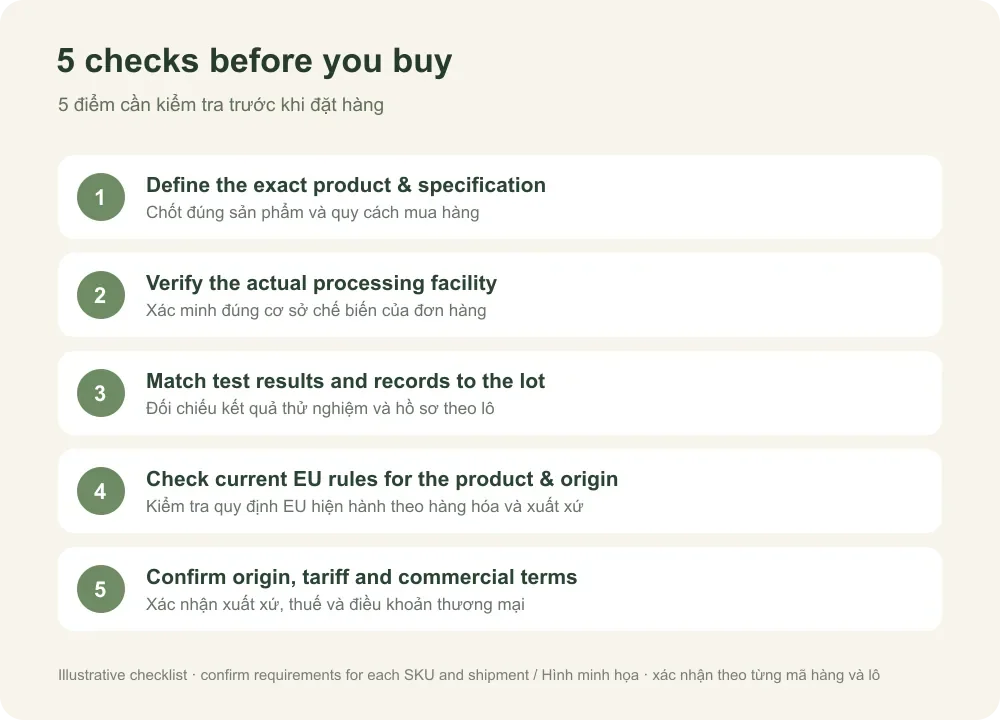
When evaluating a proposed processing facility in Vietnam, procurement teams should confirm key physical checkpoints and documented food safety management systems:
- Stainless Steel Processing Equipment: Continuous shredding, blanching, fluidized-bed drying, and vibratory sifting conveyors should be constructed from food-grade stainless steel (such as SUS 304 or SUS 316) to eliminate rust contamination.
- Foreign Matter Control: Automated processing lines should incorporate rare-earth magnets and calibrated multi-frequency industrial metal detectors (capable of identifying ferrous, non-ferrous, and stainless steel particles) immediately prior to bag filling.
- Third-Party Food Safety Management: Importers often require third-party certification benchmarked and recognized by the Global Food Safety Initiative (GFSI), such as BRCGS Food Safety or FSSC 22000, or management systems certified to ISO 22000 alongside verified HACCP programs.
- Lot-Specific Testing Documentation: Buyers should agree on pre-shipment lot testing protocols conducted by accredited independent testing laboratories (such as SGS, Eurofins, or Quatest) to confirm compliance with contract tolerances prior to container loading.
Tariff Classification (CN 0801 11 00) and Rules of Origin
Under the European Union Common Customs Tariff (Combined Nomenclature), desiccated coconut is classified under tariff subheading CN 0801 11 00. For this tariff line, the standard erga omnes (Most-Favoured-Nation / third-country) customs duty rate is listed as Free (0%) in the EU tariff schedule. Consequently, European importers do not incur an ordinary customs duty differential under the EU-Vietnam Free Trade Agreement (EVFTA) for standard import clearance.
However, verifying tariff classification and origin remains vital. Importers should confirm the exact TARIC code and destination customs procedures using the European Commission's Access2Markets portal and review the official EU-Vietnam agreement texts. Where proof of origin (such as a Certificate of Origin Form EUR.1 or a registered exporter origin declaration) is required for contractual provenance, trade statistics, preferential processing schemes, or subsequent re-export, consignments must satisfy EVFTA origin criteria:
- Wholly Obtained Origin: Coconuts must be harvested and processed entirely within the territory of Vietnam.
- Proof of Origin: A valid Certificate of Origin Form EUR.1 issued by authorized Vietnamese agencies (such as the Ministry of Industry and Trade or regional VCCI chapters), or a qualified registered exporter statement under applicable customs thresholds.
- Direct Transport Rule: Goods must be transported directly from Vietnam to the European Union without unauthorized intermediate transshipment or manipulation outside customs supervision.
Commercial Terms, Packaging, and Container Loading Logistics
Desiccated coconut is shipped in standard dry sea containers (General Purpose / Dry Van / High Cube). Because it is a dehydrated, ambient-stable commodity, active refrigeration is not required; however, strict moisture prevention during maritime transport is paramount.
Industrial Packaging Standards
The standard commercial export packaging format consists of multi-ply heavy-duty Kraft paper bags with an inner heat-sealed food-grade polyethylene (PE) liner, sealed to provide a protective barrier against ambient humidity and maritime saline air under proper transit conditions (standard 25 kg net weight). Alternative packing configurations, if required, should be specified during RFQ discussions.
Container Payload and Loading Configurations
International sea freight planning relies on standard container capacities:
- 20ft Dry Container (20'DC): Accommodates approximately 480 to 520 bags (25 kg each), representing a net cargo payload of 12.0 to 13.0 metric tons. This size is ideal for medium-sized food processors or introductory trial orders.
- 40ft High Cube Container (40'HC): Accommodates approximately 1,000 to 1,040 bags (25 kg each), yielding a net cargo payload of 25.0 to 26.0 metric tons. Importers should compare actual ocean freight costs per metric ton between 20ft and 40ft containers against destination port handling charges and carrier route surcharges.
- Moisture Protection in Transit: To mitigate the risk of container rain (condensation forming on cold container ceilings during equatorial ocean crossings), containers should be lined with kraft linerboard and fitted with calcium chloride container desiccant poles.
- Incoterms & Shipping Ports: Export quotations are standardly provided on FOB Cat Lai Port (Ho Chi Minh City) or CIF to designated European ports (such as Rotterdam, Hamburg, Antwerp, or Valencia), confirmed based on RFQ shipment parameters.
To discover complementary coconut derivatives and agricultural commodities, review FASMPO agricultural export products.
Frequently Asked Questions (FAQ) for EU Importers
- What is the difference between Fine and Medium grade desiccated coconut?
- Fine and medium grades are defined by dual-sieve particle size distributions under Codex CXS 177 (Section 2.2). Fine grade requires at least 80% m/m passing through a 1.40 mm sieve and not more than 20% m/m passing through a 0.71 mm sieve, providing a smooth texture for chocolate fillings and confectionery. Medium grade requires at least 90% m/m passing through a 2.80 mm sieve and not more than 20% m/m passing through a 1.40 mm sieve, delivering distinct coconut shreds for bakery toppings and granolas. Sieve mesh specifications must be stated in full rather than citing single minimum aperture limits.
- What is the import duty rate for Vietnamese desiccated coconut entering the EU?
- Under the EU Combined Nomenclature, desiccated coconut (CN 0801 11 00) is subject to an erga omnes (third-country) duty rate of Free (0%). Importers should confirm current TARIC measures via Access2Markets. Proof of origin such as Form EUR.1 may be provided to satisfy commercial contract provenance or regulatory origin requirements.
- What container loading configurations are standard for 25kg bags?
- A standard 20ft dry container (20'DC) typically accommodates 12 to 13 metric tons (approximately 480 to 520 bags of 25 kg), while a 40ft high-cube container (40'HC) holds 25 to 26 metric tons (approximately 1,000 to 1,040 bags of 25 kg).
Request Sourcing Assistance and Product Quotations
FASMPO assists international buyers in sourcing export-grade desiccated coconut from Vietnam. Contact our agricultural export desk to request product information, discuss packaging options, order evaluation samples, or receive a competitive container export quotation based on your target destination and delivery terms.