
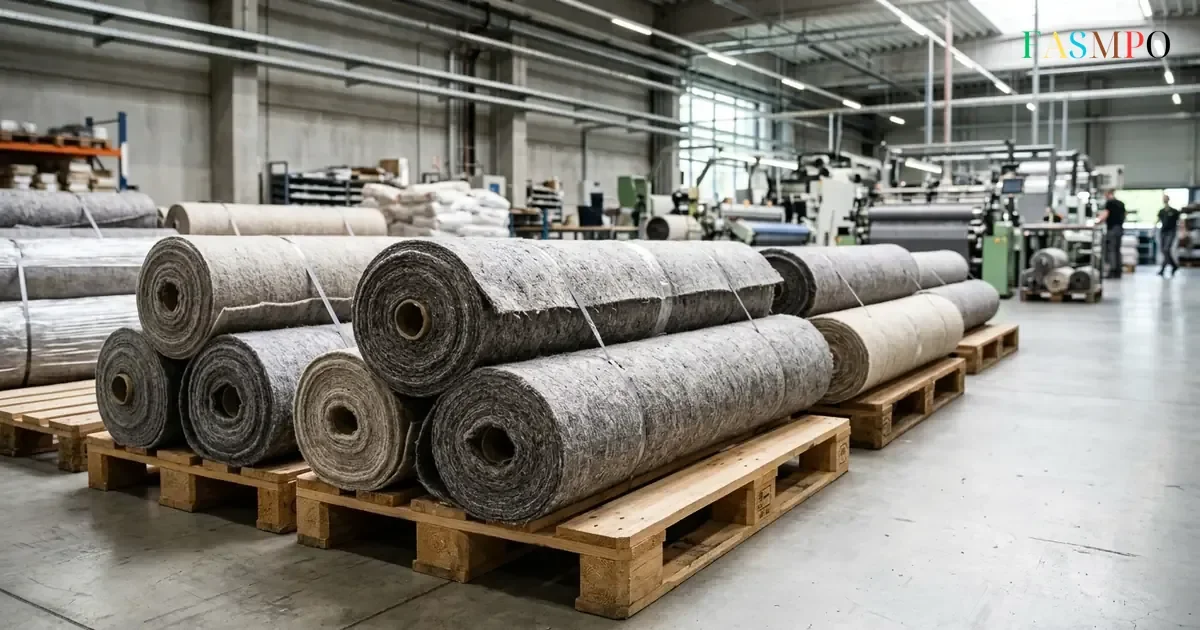
Industrial guide on needle-punched non-woven felt specifications: comparing PET vs PP fiber, density, grammage (45-3000 GSM), and operational performance.
Needle-Punched Felt Specs & Selection: PET/PP Density, GSM, and Industrial Applications
For industrial procurement managers, automotive component engineers, and filtration system designers, specifying needle-punched non-woven felt requires balancing polymer characteristics with mechanical web density. Engineered through mechanical entanglement using reciprocating barbed needles, non-woven felt fabrics eliminate traditional yarn spinning and weaving stages, delivering high isotropic tensile strength, porous permeability, and dimensional resilience. In high-stress operating environments—such as automotive cabin acoustic dampening, dust filtration bags, or geotextile ground stabilization—selecting the incorrect fiber polymer or grammage leads to premature mechanical breakdown, fiber shedding, or flow impedance. Understanding the interplay between fiber composition (PET vs. PP), grammage (45 to 3,000 GSM), and post-finishing treatments ensures optimal performance across harsh operational lifecycles.
Polymer Selection: Polyester (PET) vs. Polypropylene (PP) Fiber Performance
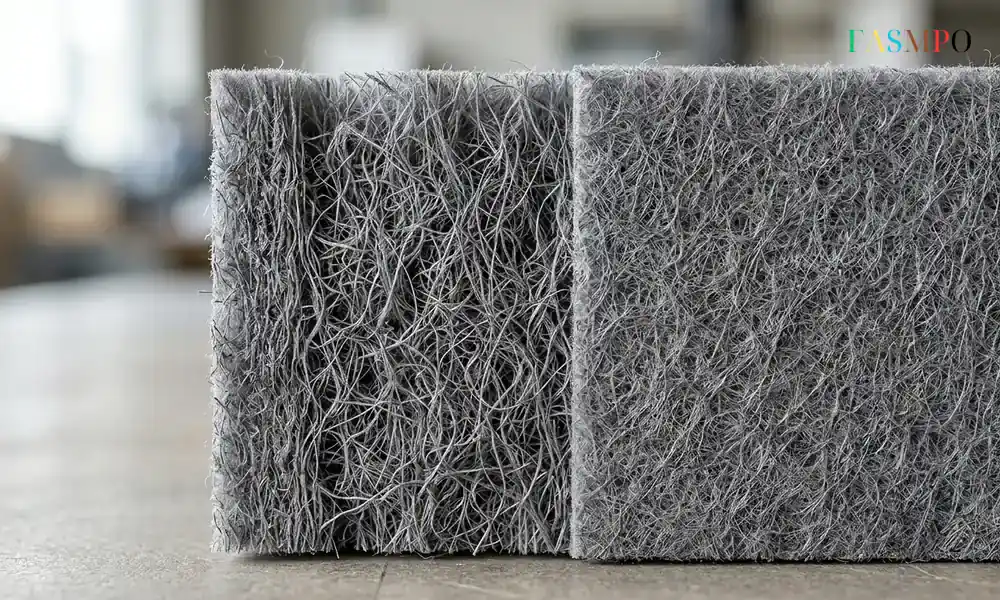
The structural baseline of any needle-punched felt begins with polymer resin selection. Raw synthetic staple fibers (Polyester Staple Fiber - PSF / recycled rPSF, and Polypropylene - PP) provide distinct physical and chemical attributes:
- Polyester (PET / rPSF): Offers high thermal resistance (melting point ~250°C to 260°C), excellent dimensional stability under sustained mechanical load, and superior abrasion resistance. PET is widely deployed in automotive interior insulation, flame-retardant structural underlayment, and high-temperature gas filtration. Incorporating Global Recycled Standard (GRS) certified rPSF allows manufacturers to meet strict corporate carbon reduction mandates without sacrificing mechanical tensile yield.
- Polypropylene (PP): Features low specific gravity (0.91 g/cm³), zero moisture absorption, and comprehensive resistance to aggressive acids, alkalis, and organic solvents. PP non-wovens are the benchmark choice for civil geotextiles, liquid filtration filter press cloths, and agricultural groundcovers where chemical inertia and moisture resistance are mandatory.
Technical Specifications: Grammage Range (GSM), Thickness & Density Calibration
Needle-punched non-wovens offer extensive flexibility in basis weight and caliper, engineered to meet specific industrial tolerances.
| Technical Parameter | Manufacturing Range / Standard Specification | Industrial Operational Impact |
|---|---|---|
| Grammage (Weight / Density) | 45 GSM to 3,000 GSM (Standard industrial baseline: 400 GSM) | Determines fabric areal density, puncture resistance (CBR), and dust-holding capacity in filtration systems. |
| Thickness (Caliper) | 0.4 mm to 20.0 mm (±5% tolerance) | Directly dictates acoustic sound absorption coefficient (NRC) and compression recovery under heavy mechanical loads. |
| Roll Width | Up to 3.2 meters maximum (Standard export rolls: 1.5m × 50m) | Minimizes joining seams in automotive flooring, roofing membranes, and civil geotextile installations. |
| Hardness / Rigidity Profile | 10 H (Soft / Flexible) to 80 H (Semi-rigid / Thermoformable) | Enables deep-draw compression molding for automotive trunk liners, door panels, and rigid storage organizer baskets. |
| Specialized Finishes | Flame Retardant (FR), Water Repellent (DWR), Anti-UV, Singed/Calendered | Satisfies transportation fire-safety regulations (FMVSS 302), outdoor weathering life, and fiber-shedding prevention. |
Acoustic NRC & Filtration Permeability Calibration
In acoustic management, felt thickness and void fraction govern the Noise Reduction Coefficient (NRC). A medium-density 400 GSM felt at 3.0 mm thickness absorbs high-frequency vibrations in vehicle engine bays and passenger footwells. In industrial baghouses, calendered or singed felt surfaces prevent fine particulate penetration into the web core, facilitating easy dust cake release during pulse-jet cleaning cycles and preventing catastrophic filter blinding.
Major Industrial Applications and Selection Guidelines
Selecting the appropriate needle-punched felt requires aligning physical specifications with exact operating stresses:
- Automotive Interiors & Protective Pads: Heavy-duty PET non-wovens (300 to 800 GSM) provide acoustic insulation, trunk lining, and specialized underbody protective pads shielding vehicles from road debris, rodent damage, and environmental abrasion.
- Industrial Air & Liquid Filtration: High-density needle felts calibrated for specific air permeability (CFM) capture fine airborne particulate in cement plants, metallurgy facilities, and chemical processing plants.
- Horticultural & Civil Engineering: UV-stabilized breathable felt fabric is converted into aeration grow bags (Felt Grow Bags) promoting healthy root pruning, as well as permeable geotextile separators preventing soil intermixing in road subgrades.
To review full material grades, tensile ratings, and custom roll conversions, explore the official Needle Punched Non-Woven Felt Product Catalogue.
Commercial Sourcing & Technical OEM Inquiries
FASMPO Co., Ltd. operates state-of-the-art non-woven manufacturing infrastructure in Vietnam with an annual output exceeding 4,000 metric tons (up to 34 × 40ft HC containers per month), certified under ISO 9001, GRS, and OEKO-TEX Standard.
For custom polymer blending, GSM formulation samples, technical data inquiries, and full container FOB/CIF quotations, contact our engineering export team at sales@fasmpo.com or visit our corporate website at https://fasmpo.com.