
Engineering guide on needle-punched coir mats export packaging: comparing hydraulic compressed rolls vs palletized sheets for 40ft HC container optimization.
Needle-Punched Coir Mats Export Packaging: Compressed Rolls vs. Palletized Sheets for 40ft HC Container Loading
For civil engineering contractors, erosion control specialists, and commercial horticultural distributors, the export packaging of needle-punched coir mats directly influences landed logistics costs, site deployment efficiency, and material mechanical properties. Manufactured from 100% natural brown coconut coir fibers mechanically interlocked via high-speed barbed needle punching, coir blankets range widely in surface weight—from lightweight horticultural grades of 300 to 500 GSM up to heavy-duty erosion-control configurations of 600 to 1,500+ GSM. Because natural coir fiber represents a high-bulk, resilient material, transport economics depend heavily on volumetric compression ratios. However, civil engineers and project managers must carefully balance volume reduction inside ocean containers against the physical recovery of tensile thickness and nominal GSM once rolls or die-cut sheets are unrolled at the job site.
Impact of Packaging Format on Landed Freight Costs for Heavy Coir Mats
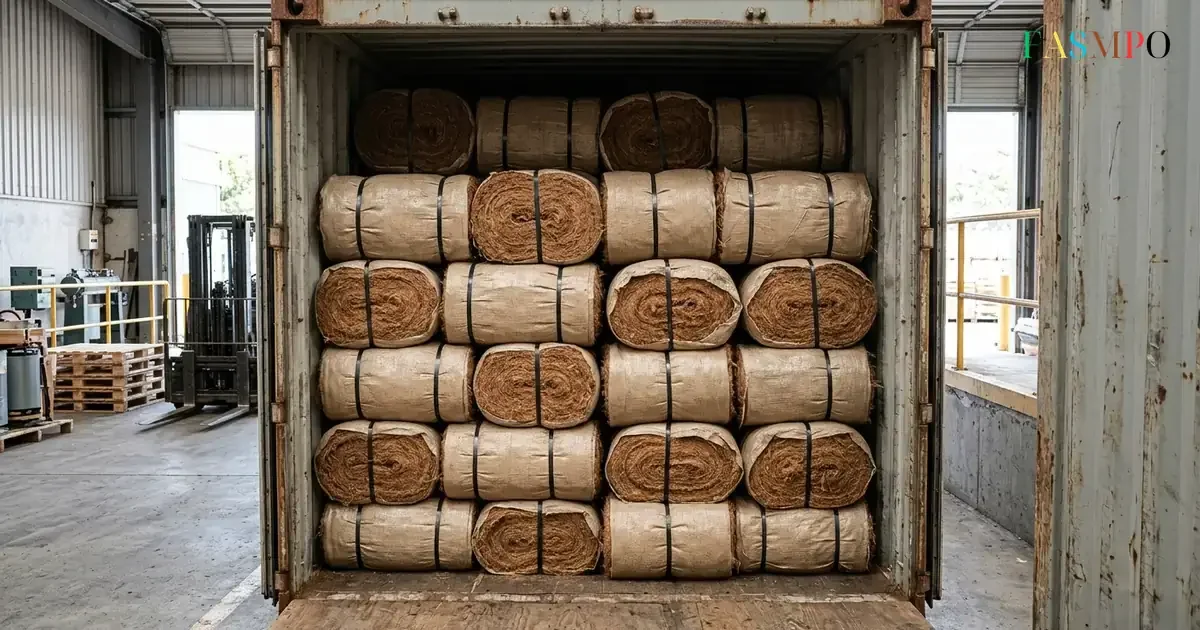
Ocean freight for bulky agricultural and geotextile commodities is primarily charged on volume or container slot capacity rather than gross weight alone. Standard, uncompressed needle-punched blankets occupy substantial cubic space due to natural fiber loft and interstitial air pockets. Without controlled compression, a 40ft High Cube container would cube out with less than 8 to 9 metric tons of coir mats, significantly inflating ocean freight expense per square meter.
Hydraulic Roll Compression vs. Flat Sheet Pallet Loading Trade-Offs
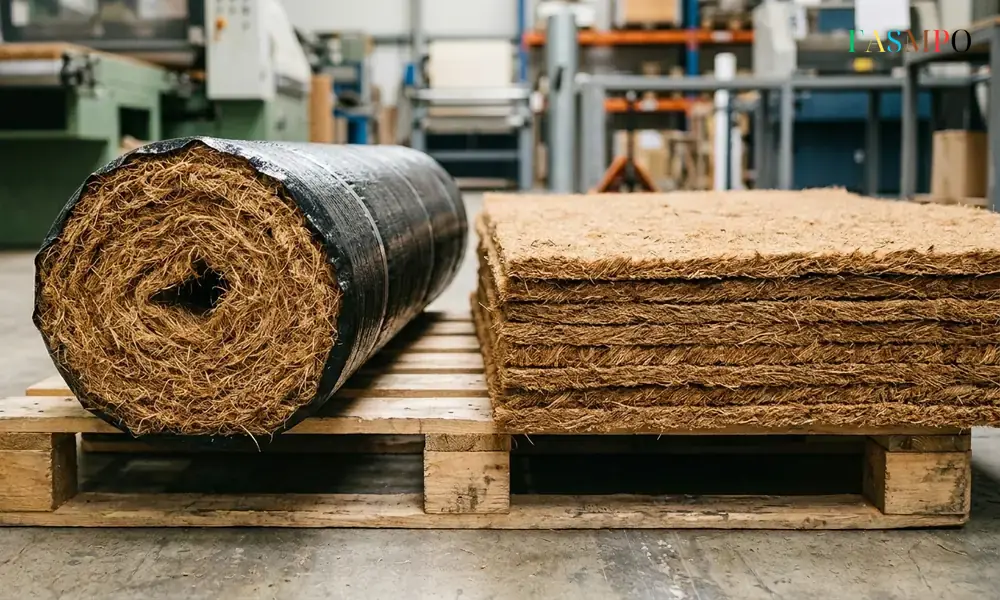
Choosing between continuous compressed roll packing and palletized flat sheets depends on specific site application methods and mechanical handling infrastructure:
- Hydraulically Compressed Continuous Rolls: Coir blankets are wound tightly around rigid cores, compressed under calibrated hydraulic rolling systems, and bound with high-tensile polypropylene banding before insertion into heavy-duty protective outer wrapping. This format maximizes container density, enabling up to 11 to 14 metric tons (or approximately 18,000 to 35,000 square meters depending on GSM) to be loaded into a single 40ft HC container. It represents the industry standard for continuous slope stabilization, riverbank embankments, and highway groundcover.
- Palletized Flat Die-Cut Sheets: Engineered for controlled horticultural applications, indoor microgreen grow pads (e.g., 25 × 50 cm mats for 1020 nursery trays), and pre-cut tree mulch discs. Sheets are stacked uncompressed or lightly compressed onto standardized wooden pallets (ISPM 15 compliant) and secured with corner protectors and stretch film. While palletization reduces total square-meter capacity per container, it eliminates curl memory, facilitates automated dispensing in nursery facilities, and speeds up forklift handling at regional warehouses.
Technical Specs: Roll Dimensions, Core Diameter & Outer PE Protection
Standardized dimensions ensure compatibility with conventional slope-unrolling rigs and tractor-mounted geotextile dispensers.
| Technical Parameter | Continuous Roll Standard Spec | Palletized Pre-Cut Sheet Spec |
|---|---|---|
| Standard Dimensions | Width: 1.0m, 1.2m, 1.5m, 2.0m (custom up to 2.4m); Length: 20m, 25m, 30m, 50m | Die-cut rectangles (e.g., 25 × 50 cm, 10 × 10 cm); Tree mulch discs (Ø20 to 60 cm) |
| Core Construction | Heavy-duty corrugated cardboard core or coreless tight-roll option (Ø 75–100 mm ID) | Heavy corrugated carton divider sheets; no internal core |
| Protective Outer Wrap | Heavy-duty UV-stabilized virgin PE tubular film or high-density woven PP sleeve | Multi-layer stretch wrap with top cover sheet and heavy corrugated base tray |
| Securing Method | Circumferential composite strapping bands (minimum 3 to 4 bands per roll) | Vertical and horizontal strapping over protective cardboard edge protectors |
| Moisture Control in Transit | Moisture baseline ≤ 16.0%–18.0%; sealed outer wrap prevents exterior water ingress | Moisture baseline ≤ 16.0%; ventilated or shrink-wrapped per end-use requirement |
Preventing Edge Damage and Fiber Degradation During Ocean Freight
The exposed edges of needle-punched rolls are particularly vulnerable to fraying and fiber dislodgement when rolls are dragged across container floors during loading and unloading. Quality-focused packaging applies reinforced end-caps or tucked-in sleeve folds secured with thermal sealing or heavy-duty wire ties. Maintaining moisture content strictly within the 15% to 18% envelope is essential: excessive moisture causes microbial heating and mold growth inside airtight PE sleeves during tropical transits, whereas over-drying (< 10%) can render coir fibers brittle, reducing post-compression elastic rebound.
Optimizing 40ft HC Payload Efficiency for 400 to 900 GSM Coir Mats
Container packing plans vary according to the nominal GSM rating of the coir blanket:
- Lightweight Erosion Blankets (300 to 500 GSM): Highly compressible. Standard 40ft HC floor loading can accommodate between 28,000 and 35,000 square meters of material, achieving payloads between 11.0 and 14.0 metric tons.
- Medium to Heavy-Duty Mats (600 to 900 GSM): Used on steep cut slopes and watercourses. A 40ft HC container typically accommodates 18,000 to 24,000 square meters (payload approximately 12.0 to 14.5 metric tons depending on roll length and core specification).
- Heavy Mattress / Industrial Felts (1,000 to 1,500+ GSM): Lower roll compression yields total container capacity between 8,000 and 12,000 square meters, achieving gross container payload close to 14.0 to 16.0 MT.
Floor Loading vs. Palletized Handling at Destination Warehouses
Floor-loading roll configurations maximize raw container payload and minimize ocean freight cost per square meter. However, destination importers must possess roll-clamp forklift attachments or manual labor to strip the container. Conversely, palletized shipments reduce container volume by 20% to 30% due to pallet height and vertical gaps, but allow direct warehouse racking without extra restacking labor. Project procurement teams should calculate total landed cost including local drayage and devanning expenses before finalizing packaging selections.
To review comprehensive physical specifications and production tolerances, explore our coir mat manufacturing specifications.
Commercial Sourcing & Technical Packaging Inquiries
FASMPO Co., Ltd. manufactures and exports high-performance needle-punched coir blankets, latex-free horticultural grow pads, and erosion control textiles from Vietnam, supporting custom roll widths, specific compression profiles, and OEM container stowage plans.
To request detailed technical data, custom roll cut configurations, and competitive FOB or CIF quotations, contact our engineering export desk at info@fasmpo.com or visit our online resource center at https://fasmpo.com.