

A practical guide for project engineers to evaluate PET acoustic panel test reports, matching density, thickness, mounting method, and ISO 354 / ASTM C423 standards.
Submittal evaluation for commercial acoustic projects requires rigorous auditing of supplier test reports against contract documents. Reviewing laboratory test certificates ensures that submitted test data matches the exact physical item, installation mounting method, and compliance scope required on site.
Submittal Verification Checklist for Project Engineers
When auditing acoustic submittal packages, project engineers should verify submittals against the following four-point verification checklist:
- 1. Specimen Physical Configuration: Verify that the test certificate explicitly identifies the sample thickness (such as 9 mm, 12 mm, or 24 mm), basis weight, and density. A test report for one thickness grade cannot substantiate another thickness grade.
- 2. Installation Mounting Conditions: Confirm whether the laboratory test specimen was evaluated under direct mount conditions or with an air cavity (such as a 50 mm air gap). Sound absorption target ratings vary significantly between direct and cavity mount assemblies.
- 3. Test Method and Standard: Ensure testing was conducted under recognized standards such as ISO 354 or ASTM C423, with test specimens mounted according to standard laboratory protocols.
- 4. Regulatory Scope and Compliance Reports: Confirm applicability of source-referenced fire retardancy classifications (such as ASTM E84 Class A with Flame Spread Index ≤25, Smoke Developed Index ≤450; or EN 13501-1 Class B-s1, d0) and formaldehyde emission standards (such as E0 grade ≤0.05 mg/m³ under EN 717-1 or ASTM D6007) against project compliance submittals.
Treat catalog figures as source-listed targets pending official test reports
Catalog performance metrics represent source-listed target ranges, and report evidence should match the product/configuration tested (including thickness and mounting); assess lot/product scope when required by the applicable standard or project submittal. For instance, catalog target NRC values—such as 0.40–0.45 (direct) or 0.70–0.75 (50 mm gap) for 9 mm panels; 0.45–0.55 (direct) or 0.80–0.85+ (50 mm gap) for 12 mm panels; and 0.70–0.80 (direct) or 0.90+ (50 mm gap) for 24 mm panels—serve as design reference targets to be matched against corresponding laboratory test documentation.
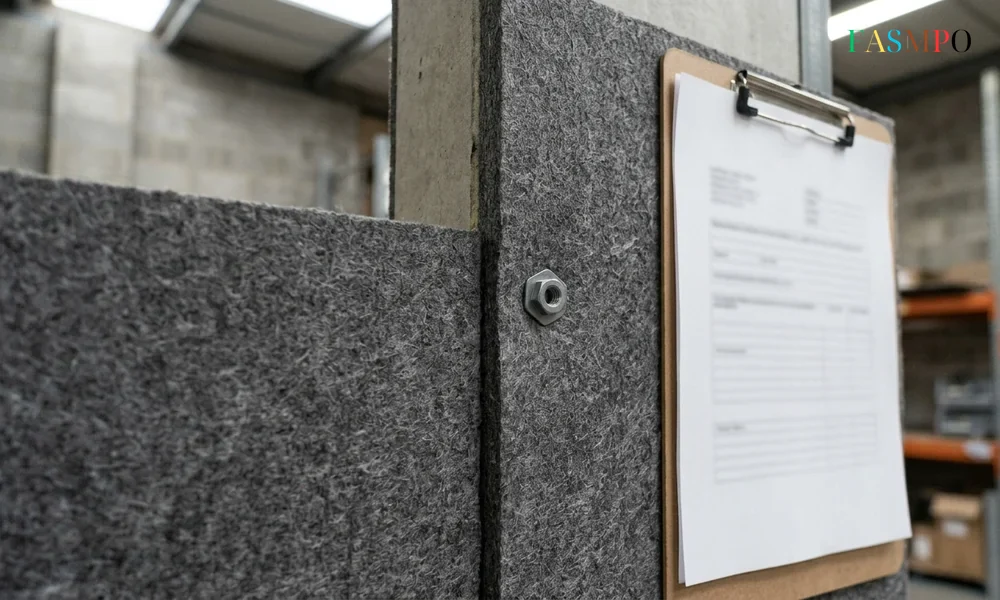
Record missing configuration details as formal submittal RFI items
If a submitted test report omits details regarding sample mounting methods, air cavity depth, or density parameters, record these gaps as formal Requests for Information (RFI) to the supplier prior to issuing submittal approval.
For detailed verification guidance, review our ACOUSTIC PANELS FACTORY IN VIETNAM catalog.
Contact FASMPO Technical Support:
Email: info@fasmpo.com
Website: https://fasmpo.com