
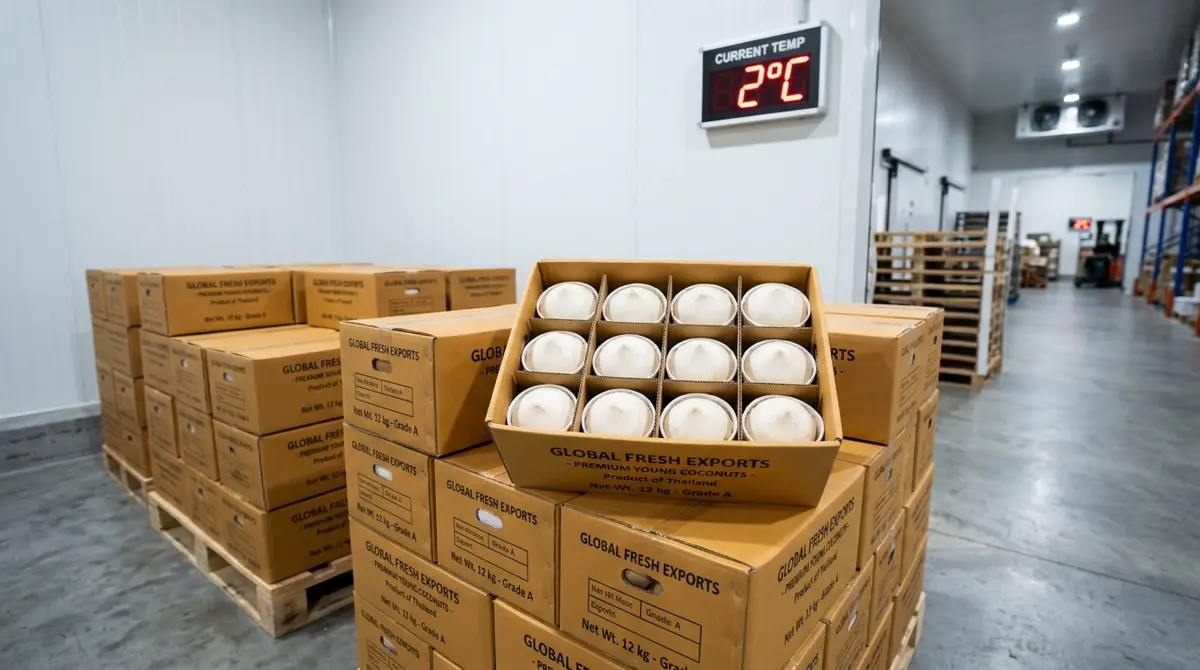
Source ready-to-drink fresh polished coconuts from Vietnam. Compare cold chain specs (1–3°C), 1,400 carton reefer loading, and B2B wholesale packing.
Fresh Polished Coconut Export Guide: Sourcing Ready-to-Drink Coconuts for B2B Retail & Foodservice
Vietnam's Mekong Delta, particularly the alluvial groves of Ben Tre province, produces premium Siamese fragrant coconuts celebrated for crisp sweetness, refreshing taste, and natural hydration. For international fresh produce importers, commercial retail distributors, and hospitality buyers, sourcing fresh polished coconut (also commercially known as bald or naked coconut) provides a high-efficiency solution that dramatically reduces ocean shipping volume while delivering an effortless, knife-free drinking experience to consumers.
What is Fresh Polished Coconut: Advantages for Modern Import Supply Chains
Fresh polished coconut represents a specialized post-harvest format where the fibrous outer exocarp and spongy mesocarp husk are meticulously shaved away down to the hard inner endocarp shell. The resulting nut features a smooth, ivory-white, polished surface that delivers notable commercial advantages across long-distance distribution networks.
Fully Peeled and Polished to the Shell: Maximizing Container Volume and Shelf Appeal
Traditional whole coconuts and diamond-cut fruit carry substantial excess husk volume that adds deadweight and consumes refrigerated container capacity. By removing the thick fibrous husk completely down to the shell, polished coconuts feature a substantially smaller physical footprint than whole green coconuts, allowing a higher count of edible fruit units to fit within a standard container space. On retail display shelves, the clean spherical form provides an eye-catching, hygienic presentation that aligns perfectly with premium supermarkets, airport grab-and-go kiosks, and upscale juice bars.
Ready-to-Drink Convenience: Instant Straw Access via the Natural Soft Eye
A primary barrier for European and North American consumers purchasing fresh coconuts is opening difficulty. Fresh polished coconuts eliminate the necessity for cleavers, mechanical puncturing tools, or hazardous cutting. During processing, the natural germination pore (the soft eye) is carefully cleaned and exposed. Consumers or foodservice staff simply press a standard food-grade drinking straw directly through this natural opening to enjoy pure, chilled coconut water within seconds.
Key Technical Specifications and Quality Standards
Successful international procurement requires establishing explicit quality tolerances prior to shipment booking. Below are the commercial specifications published by FASMPO for Vietnamese polished coconut exports:
| Technical Parameter | Export Specification Standard (FASMPO Listing) |
|---|---|
| Botanical Variety | Siamese Coconut (Dừa Xiêm Xanh), Ben Tre Province, Vietnam |
| Sugar Content (Brix) | Measured above 7.0° Brix as listed on FASMPO's English product page |
| Packaging Format | 9, 10, or 12 pieces per carton as listed by FASMPO (or per buyer request; carton ventilation design to be specified in RFQ) |
| Cold Chain Storage Temperature | 1°C to 3°C (34°F to 37.4°F) listed by FASMPO alongside reefer loading data (storage/transit scope and continuous monitoring confirmed per shipment RFQ) |
| Reefer Payload (20RF) | 700 export cartons (approximately 6,300 to 8,400 coconuts) |
| Reefer Payload (40RF) | 1,400 export cartons (approximately 12,600 to 16,800 coconuts) |
| Factory Supply Capacity | 10 to 15 reefer containers (40RF) per month (FASMPO published capacity) |
| Production Lead Time | 4 to 5 days per 40RF container (as listed by FASMPO) |
| Cold Storage Shelf Life | FASMPO lists a 60-day warranty period on its product page, while post-harvest literature (Hort. J.) notes approx. 2–3 weeks of commercial quality for polished young coconuts and USDA guidelines cite 3–4 weeks for wrapped shaped coconuts at 3°C–6°C (commercial warranty conditions must be confirmed in buyer sales contracts) |
Natural Sweetness and Brix Profile (>7° Brix)
Harvest timing directly influences natural sweetness. Siamese coconuts are typically harvested at the young drinking stage when liquid endosperm volume and natural sweetness are well developed. On its English product listing, FASMPO specifies a sweetness level above 7.0° Brix for export fresh polished coconuts. To understand testing methods and optical measurement calibration, review our technical guide on Brix degree and sweetness standards in fresh coconuts.
Critical Quality Controls: Clean Husk Shaving and Shell Integrity
Once shaved, the absence of outer fibrous husk leaves the inner nut vulnerable to ambient desiccation and contamination if improperly handled. In commercial export handling, standard post-harvest practices typically involve washing with clean water, thorough surface drying, and individual protective wrapping in food-grade film to preserve moisture and protect the exposed shell during transit. Quality screening prior to carton packing focuses on sorting out fruit with hairline shell fractures, leaky seams, or bruised soft eyes.
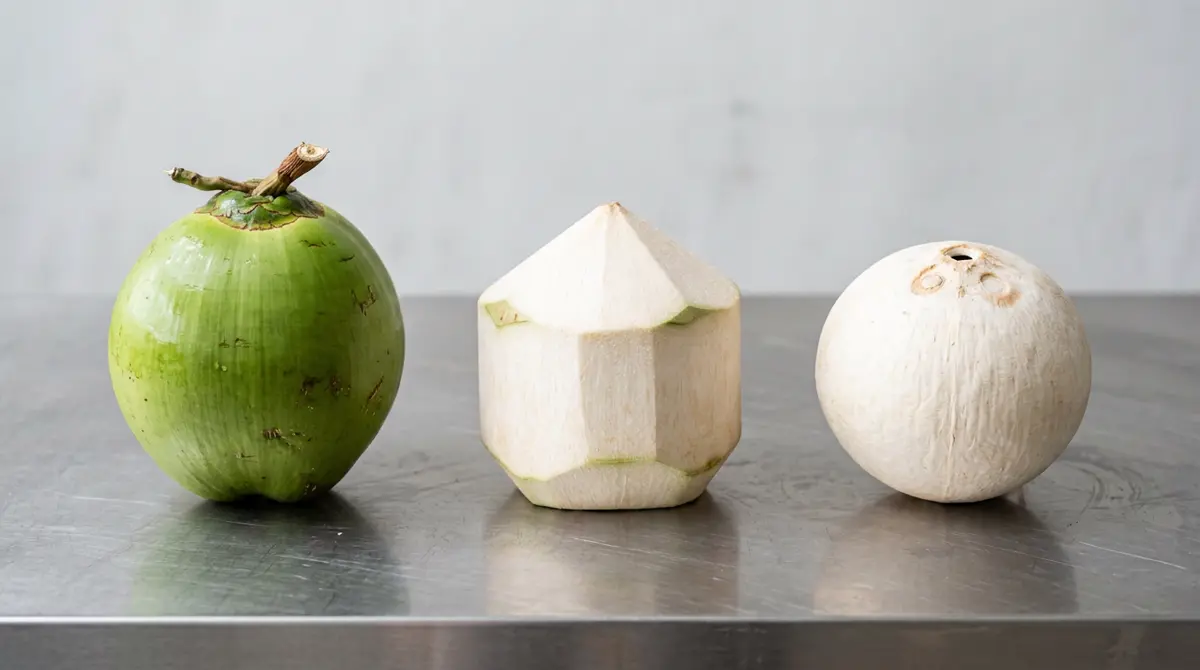
Comparative Analysis: Polished vs Diamond Cut vs Whole Fresh Coconut
Procurement officers must balance consumer presentation against freight expenditure when selecting coconut export formats:
| Comparison Factor | Fresh Polished Coconut | Diamond Cut Coconut | Whole Green Coconut |
|---|---|---|---|
| Husk Preparation | Completely shaved to shell, smooth finish | Trimmed into hexagonal pyramid base and tip | Intact outer green fibrous husk |
| 40RF Container Capacity | 1,400 cartons (12,600–16,800 pcs) as listed by FASMPO | Lower piece count estimated based on husk volume (subject to specific packing specs) | Lowest piece count estimated due to bulky outer green husk (subject to specific packing specs) |
| Freight Efficiency Consideration | Higher theoretical fruit density per container (actual unit freight subject to verification against packing specs) | Estimated moderate density due to residual trimmed husk (commercial loading data to be confirmed per spec) | Estimated lower density due to large bulky green husk (commercial loading data to be confirmed per spec) |
| Opening Method | Straw inserted directly into soft eye | Requires cleaver or opening tool to cut tip | Heavy cleaver required to chop thick husk |
| Primary Channel | Modern retail shelves, grab-and-go, HoReCa | Ethnic grocery, supermarket produce sections | Wholesale terminal markets, processing |
Importers evaluating bulk young fruit varieties can inspect our full catalog from a fresh polished coconut supplier to review available box formats and fruit caliber grading.
Cold Chain Management and Export Container Logistics
Because polished coconuts lack the thermal cushioning of outer fibrous husk, precise temperature discipline is non-negotiable from packing shed palletization to destination delivery.
Temperature Parameters: Cold Chain Management at 1–3°C
On its product page, FASMPO lists a temperature range of 1°C to 3°C (34°F to 37.4°F) alongside reefer container loading specifications. Importers should confirm with the supplier whether this target applies to pre-shipment warehouse storage, ocean reefer transit, or both, and verify pre-cooling protocols and continuous data-logger monitoring per shipment. Regarding commercial longevity, FASMPO's listing indicates a 60-day commercial warranty, whereas post-harvest research on polished young coconuts notes commercial quality retention of approximately 2 to 3 weeks, and USDA commercial storage guidelines cite 3 to 4 weeks for wrapped shaped young coconuts kept at 3°C to 6°C. Importers should reconcile this variance by confirming specific warranty coverage terms, pre-cooling benchmarks, and temperature limits directly in buyer sales agreements. For an in-depth analysis of cold room protocols and post-harvest respiration, consult our resource on selecting and preserving fresh young coconuts.
Export Packaging: Standard 9–12 Piece Cartons and Ventilation Considerations
FASMPO lists standard packaging at 9, 10, or 12 pieces per export carton, with custom packing configurations available upon customer request. In maritime cold chain transit, buyers commonly specify multi-ply corrugated cartons with moisture-resistant finishes and lateral ventilation slots to facilitate chilled airflow across pallet stacks. Importers should confirm their exact carton strength and ventilation specifications during the RFQ process.
Supply Capacity and Lead-Time Planning
According to FASMPO's published specifications, packing operations maintain a supply capacity of 10 to 15 reefer containers (40RF) per month. Harvesting and processing a full 40RF container (1,400 cartons) requires 4 to 5 days as listed by FASMPO. Overseas buyers should establish rolling supply contracts 3 to 4 weeks in advance, particularly during peak summer consumption windows and holiday promotional periods.
Essential Sourcing Checklist for B2B Importers
To avoid clearance delays and unexpected quarantine holds at destination ports, buyers should verify regulatory checkpoints before confirming sea transit.
Critical Parameters to Specify in Your RFQ
- Caliber and Packaging: Specify preferred piece count per carton (9, 10, or 12 pieces), fruit circumference tolerances, and carton structural strength requirements.
- Cold Chain Verification: Confirm target transport temperature (1°C–3°C as listed by FASMPO), pre-cooling confirmation, and placement of continuous temperature data loggers.
- Incoterms and Payment: Indicate target port of discharge with delivery terms (FOB Ho Chi Minh City / CIF destination) and preferred settlement (T/T or L/C).
Import Compliance and Verification Checkpoints
B2B fresh coconut procurement requires distinguishing among distinct regulatory, safety, and quarantine standards. Importers must confirm specific requirements with their destination authorities: facility food safety management systems (such as HACCP principles or BRC Global Standards), plant health traceability via planting-area codes (PUC / mã số vùng trồng) issued by agricultural authorities, and importing-country registration protocols (such as US FDA food facility registration). Cross-referencing destination National Plant Protection Organization (NPPO) regulations ensures appropriate phytosanitary certificates and import permits are aligned prior to cargo departure. For detailed regulatory standards governing European and American ports, see our guide on fresh coconut export standards for Europe and the US.
Frequently Asked Questions (FAQ)
- How does polished coconut maintain freshness during ocean transit?
- Freshness is maintained through post-harvest handling, hygienic surface preparation, protective film wrapping, and ventilated carton packaging, alongside refrigerated conditions (with 1°C to 3°C listed by FASMPO alongside reefer loading data). Buyers should confirm the exact temperature target (storage vs transit) and continuous monitoring protocols in their RFQ.
- What is the loading capacity in standard 20RF and 40RF reefer containers?
- A standard 20ft reefer container (20RF) holds 700 export cartons (6,300–8,400 coconuts), whereas a 40ft high-cube reefer container (40RF) accommodates 1,400 export cartons, corresponding to 12,600 to 16,800 coconuts depending on carton count configuration.
- Can buyers request custom carton printing and specific fruit sizing?
- FASMPO's listing indicates standard packaging of 9, 10, or 12 pieces per carton alongside custom options upon request. Specific customization requirements—such as private label artwork, barcode printing, and fruit caliber calibration—should be specified during contract negotiations and confirmed in buyer sales agreements.
Request Product Information and Export Quotation
FASMPO supplies premium fresh polished coconuts to international supermarkets, wholesale distributors, and food service chains worldwide. Contact our agricultural export desk to request product information, custom packaging configurations, container loading schedules, or a formal FOB/CIF price quotation. Please include your destination seaport and anticipated monthly volume to receive an expedited commercial proposal.