
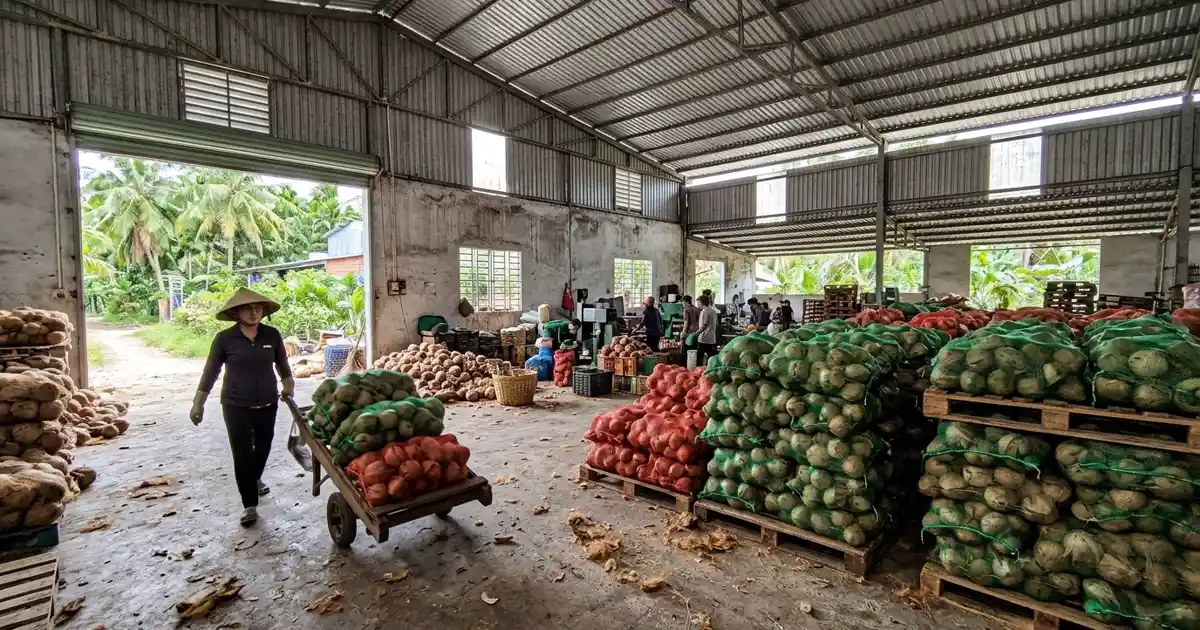
Compare Grade A and Grade B semi-husked dried coconut by fruit size, weight, packaging and stated shelf life before requesting a quote.
How to Choose Dried Coconut Specifications for Food Applications
For a food operation, “dried coconut” can refer to different product forms. This brief covers semi-husked whole dried coconuts in Grade A retail and Grade B raw-material categories. It does not describe desiccated coconut or another processed coconut ingredient. Before comparing offers, confirm that your receiving and production steps can handle whole fruit.
The specifications below are the documented catalog values. Use them to frame a request for quotation, then confirm the requirements for the intended order with the supplier.
Start with the Form of Coconut Your Production Line Can Handle
Confirm the material form before comparing grades
The product scope is semi-husked dried coconut. A buyer planning to receive whole fruit should check that its process can accept this form. If the line requires a prepared ingredient, ask the supplier to confirm whether that distinct product is available; do not treat whole dried coconut as interchangeable with processed coconut ingredients.
The catalog assigns Grade B to raw-material use and Grade A to retail. Those labels help organize the initial inquiry, but they do not establish a buyer-specific yield, processing result or finished-product performance.
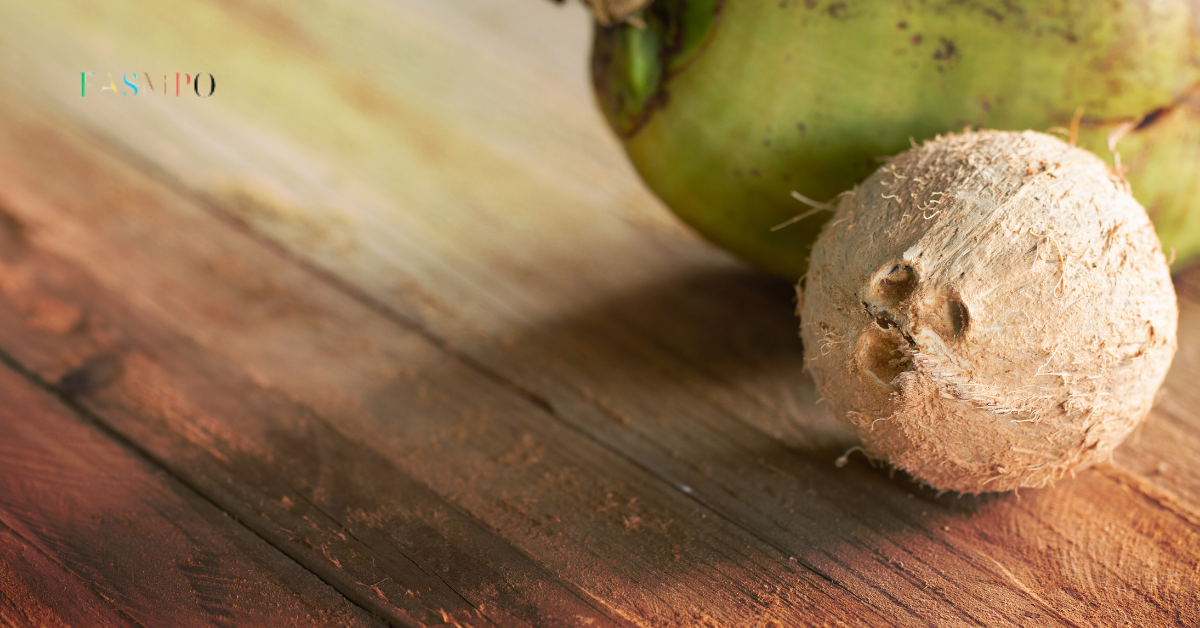
Choose Grade A or Grade B Based on the Buying Channel
Compare the catalog's stated applications and minimum weights
Grade B is listed for food and non-food processing and has a minimum fruit weight of 700 g. Grade A is listed for foodservice, restaurants, households and retail, with a minimum fruit weight of 800 g. Select the category that matches your buying channel, then confirm any order-specific acceptance criteria.
- Grade B: raw-material category; listed for food and non-food processing; minimum 700 g per fruit; stated shelf life 45–60 days.
- Grade A: retail category; listed for foodservice, restaurants, households and retail; minimum 800 g per fruit; stated shelf life 5–6 months.
The brief does not specify storage conditions or a shelf-life test method. Treat the figures as catalog-stated values and confirm how shelf life applies to the shipment and your storage plan.
Match Fruit Size, Weight and Copra Thickness to Your Process
Use the shared measurements as screening criteria
Both grades share the catalog values of 12–15 cm fruit diameter, 11–16 mm copra thickness, fat content above 60%, an unsprouted condition and 100–150 ml water content per fruit. The minimum fruit weight differs by grade: at least 700 g for Grade B and at least 800 g for Grade A.
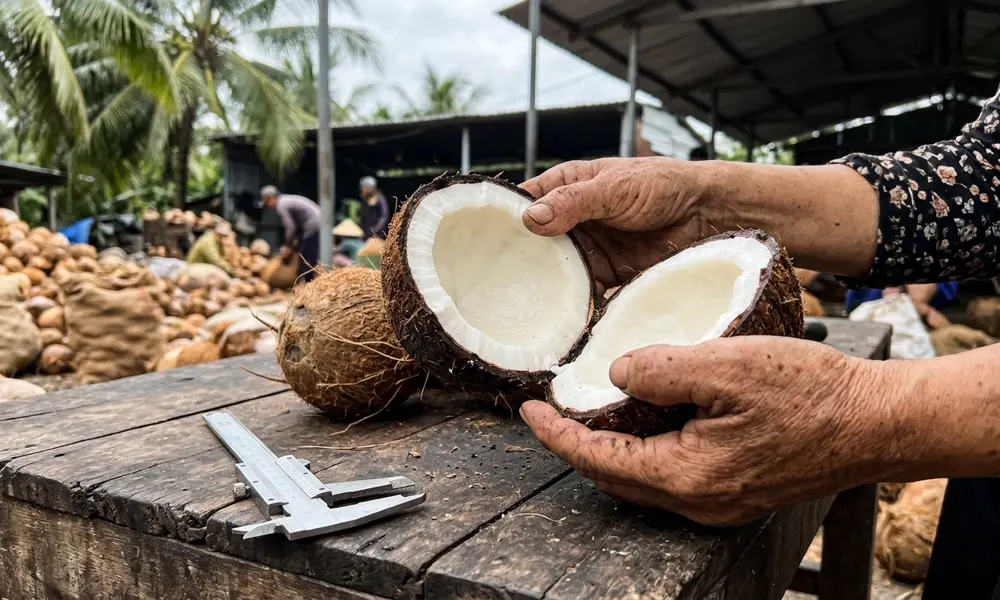
Compare these values with your own incoming-material specifications. The brief does not provide a processing yield, tolerance range beyond the stated figures, or a performance result for a particular recipe or production line.
Plan Packaging and Shelf Life for Storage and Distribution
Confirm the bag specification and the time window
The listed packaging is mesh bags at 20–25 kg per bag. The stated shelf life is 45–60 days for Grade B and 5–6 months for Grade A. These are the only packaging and shelf-life details locked in the brief; it gives no pallet configuration, container loading quantity, storage temperature or other handling condition.
Before placing an order, confirm the bag weight available for your lot, the dispatch and arrival schedule, and the supplier's instructions for storage. Do not infer a shelf-life guarantee under conditions that have not been specified.
What to Include in a Dried Coconut RFQ
Make the requested grade and commercial basis explicit
A useful request for quotation should identify the semi-husked dried coconut form, Grade A or Grade B, intended buying channel, target bag weight within the listed 20–25 kg range, destination, quantity and preferred delivery term. Ask the supplier to confirm the applicable product specifications and shelf-life basis for the order.
- Commercial terms listed in the brief: FOB, CIF, CFR or DDP.
- Payment terms listed: T/T or L/C.
- Minimum order quantity: 1 x 40HC.
- Free testing samples are available; confirm sample arrangement and shipment details.
FASMPO Company Limited's coconut business profile states 20+ years in the Mekong Delta, 10,000 ha of owned growing area, annual capacity of 60,000 tonnes and 600 containers per year. These are company-level figures, not a shipment-specific allocation or a guarantee of availability for a requested date.
Request a Sample or FOB/CIF Quote
Contact FASMPO Company Limited to request a free testing sample or a quotation on FOB or CIF terms. Include the required grade, destination, quantity and preferred bag weight so the order details can be confirmed.
Email: info@fasmpo.com | WhatsApp: +84938741145 | Website: fasmpo.com
Sources
- Shared/KnowledgeBase/fasmpo_coconut_eco_charcoal.md — “Dừa Khô Xuất Khẩu (Dried Coconut — Semi-Husked)”.
- Shared/KnowledgeBase/fasmpo_company_profile.md — coconut business capacity and commercial terms.