
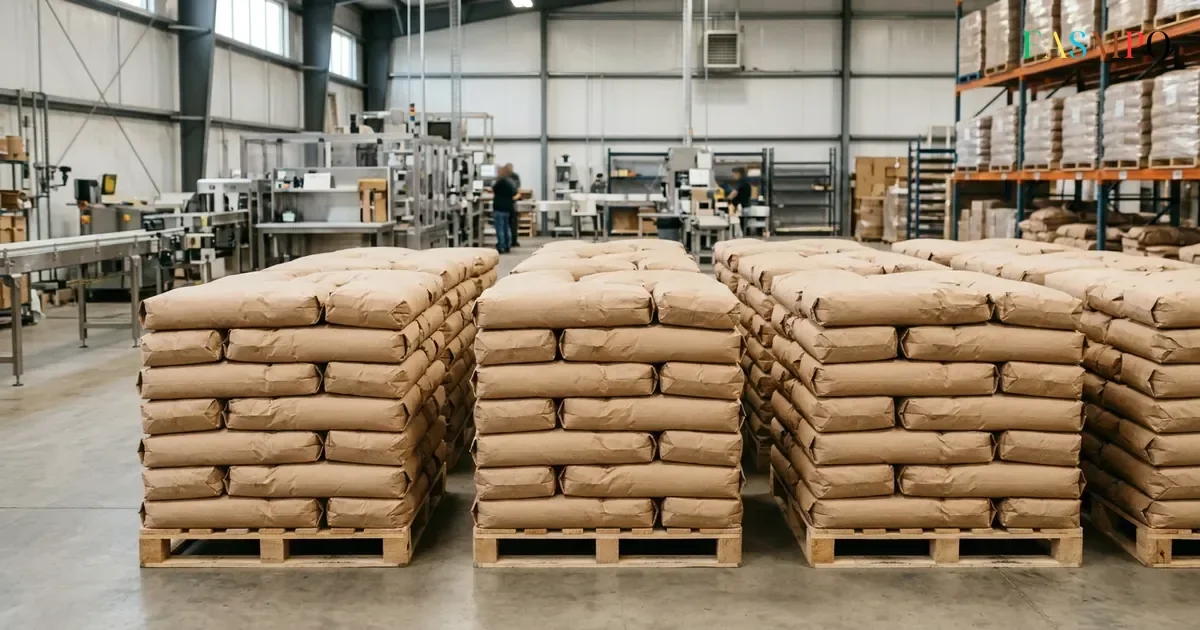
Sourcing guide for desiccated coconut packaging standards: multi-wall 25kg Kraft bags, PE liners, moisture barrier properties, and container payload efficiency.
Desiccated Coconut Packaging Standards: 25kg Kraft Bags with Inner PE Liner for Bulk Importers
For industrial bakery manufacturers, confectionery producers, and bulk food ingredient importers, procurement specifications for desiccated coconut extend far beyond initial fat content and mesh size. Because high-fat coconut kernel contains 62.0% to 66.0% natural lipids, the physical integrity of export packaging directly governs product stability throughout maritime transit and warehouse storage. In tropical export origins such as Vietnam's Mekong Delta, ambient relative humidity frequently exceeds 80%, creating an immediate vapor pressure gradient against dried coconut products stabilized at or below 3.0% moisture. Without rigorous multi-barrier containment, atmospheric moisture ingress triggers lipid hydrolysis, accelerating Free Fatty Acid (FFA) accumulation beyond commercial acceptance thresholds (FFA ≤ 0.30%) and inducing premature rancidity, clumping, and off-flavors.
Why Packaging Specifications Matter for High-Fat Desiccated Coconut Imports
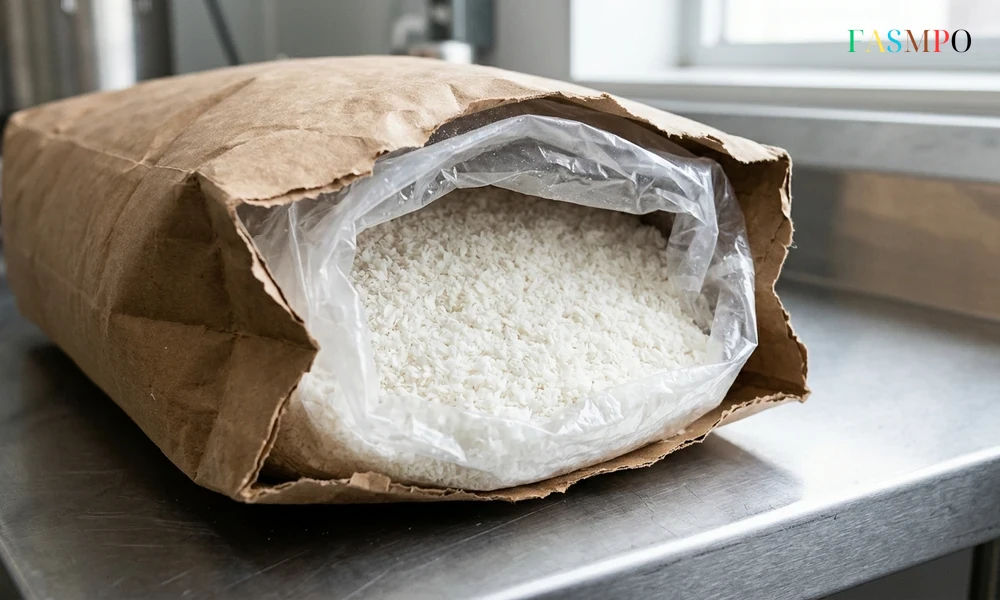
During long-haul ocean container freight—often spanning 20 to 45 days through fluctuating maritime climate zones—uncontrolled ambient moisture represents the single greatest threat to dried coconut kernel. When water vapor penetrates bulk packaging, the equilibrium moisture content of the desiccated coconut increases rapidly. Once product moisture exceeds 3.0%, lipase enzymatic activity and hydrolytic oxidation initiate rapidly, breaking down triglyceride chains into free lauric acid.
Moisture Barrier Role of Multi-Wall Kraft Bags and PE Food-Grade Liners
To isolate dried coconut flakes from external atmospheric factors, international export packing relies on a synergistic dual-barrier mechanism:
- Multi-Wall Kraft Outer Sacks (3-ply to 4-ply virgin Kraft paper): Provide structural durability, high tensile strength, puncture resistance, and physical protection against mechanical abrasion during automated conveying, pallet stacking, and ocean container movement. Virgin Kraft paper allows controlled breathability while protecting internal food-grade layers from external abrasion.
- Inner Polyethylene (PE) Liner: Acts as the primary hermetic moisture and vapor barrier. Virgin low-density polyethylene (LDPE) liners eliminate water vapor transmission and prevent volatile natural coconut aromatic compounds from evaporating. Crucially, the inner liner prevents lipid migration into the Kraft paper layers, ensuring oil staining and structural weakening of the paper bag do not occur.
Standard export supply also incorporates an outer woven polypropylene (PP) bag or an integrated poly-woven protective over-wrap where manual transshipment handling requires enhanced tear resistance across destination ports.
Standard Export Packaging Specifications: 25kg and 50kg Bags
Commercial food processing facilities generally prefer standardized unit bag sizes that integrate seamlessly into batch mixing schedules without requiring intermediate weigh-ins.
| Technical Parameter | Standard 25kg Export Pack | Heavy-Duty 50kg Export Pack |
|---|---|---|
| Net Weight per Unit | 25.0 kg net weight | 50.0 kg net weight |
| Bag Outer Construction | 3-ply or 4-ply virgin extensible Kraft paper sack (70–80 GSM/ply) | 4-ply virgin Kraft paper sack with reinforced outer woven PP jacket |
| Inner Barrier Liner | Virgin food-grade LDPE liner (approx. 40–60 microns) | Reinforced food-grade LDPE liner (approx. 60–80 microns) |
| Closure Method | Continuous heat-sealed inner PE liner; heavy-duty stitched paper top with crepe tape | Heat-sealed or tied inner liner; reinforced multi-stitch top closure |
| Target Baseline Quality | High Fat ≥ 62.0%, Moisture ≤ 3.0%, FFA ≤ 0.30% | High Fat ≥ 62.0%, Moisture ≤ 3.0%, FFA ≤ 0.30% |
PE Liner Thickness Micron & Heat Sealing Against Rancidity Risk
Liner film thickness is an essential engineering control. Sub-standard thin films (< 30 microns) risk pinhole micro-punctures during packing, particularly when pressurized by sharp particle edges or pneumatic filling spouts. A food-grade LDPE film of 40 to 60 microns provides sufficient tensile yield strength and flexibility. Furthermore, manual twist-and-tie liner closures carry human error risks; automated thermal heat sealing ensures an airtight closure that preserves nitrogen flushes (when requested) and isolates the coconut from ambient oxidative catalysts.
Container Loading & Palletization Efficiency for 20ft and 40ft HC
Freight optimization is critical in B2B supply chains. Bulk buyers choose between floor loading (manual stowing) and standardized palletization based on discharge port unloading facilities, container demurrage allowances, and labor costs.
| Loading Configuration | 20ft General Purpose (20ft DC) | 40ft High Cube (40ft HC) |
|---|---|---|
| Floor-Loaded (Loose Stowed 25kg Bags) | 480 – 520 bags (~12.0 – 13.0 MT net weight) | 1,000 – 1,040 bags (~25.0 – 26.0 MT net weight) |
| Palletized & Stretch-Wrapped (1.0m x 1.2m pallets) | 10 standard pallets (~10.0 – 11.0 MT net weight) | 20 – 21 standard pallets (~20.0 – 22.0 MT net weight) |
| Transit Protection Stowing Strategy | Kraft corrugated lining on container walls; bottom pallet or moisture barrier kraft sheet | Wall corrugated lining, anti-slip interlock stacking, container desiccant bags |
Maximizing Net Payload While Preventing Bag Rupture in Transit
While floor loading achieves maximum net payload (25.0 to 26.0 metric tons per 40ft HC container), it requires careful stowage planning. Stevedores must ensure interlocking brick-pattern bag arrangement to eliminate void spaces that cause load shifting during rough sea state transits. Placing corrugated cardboard along container sidewalls and floor beams prevents bag snagging on structural steel corrugations. At destination facilities with automated forklift unloading, palletized shipments wrapped with heavy stretch film and protective corner boards reduce warehouse handling hours, despite sacrificing roughly 15% to 20% in net container capacity.
For comprehensive product specifications and grade profiles, review the benchmark export parameters on our desiccated coconut product catalog.
Commercial Sourcing & Packaging Inquiries
FASMPO Co., Ltd. coordinates direct-from-source bulk desiccated coconut manufacturing across certified facilities in Ben Tre Province, Vietnam, supplying High Fat Fine and Medium grades packed to buyer technical specifications.
For custom packaging schedules, OEM printing, palletization configurations, and current FOB/CIF container quotations, contact our B2B commercial export team directly via email: info@fasmpo.com or visit our corporate portal at https://fasmpo.com.